

What Does the Bible Say About Intimacy in Marriage? A Gentle Answer
Some links in this article are affiliate links. If you buy through them we may earn a commission, at no extra cost to you. We only recommend resources we believe honor marriage.
If you typed “what does the Bible say about intimacy in marriage” into your phone tonight, I doubt you wanted a list of verses. I think you wanted to know whether something is wrong with you, or with your marriage, or with your faith.
Maybe the house is finally quiet, the kids are down, and you’re lying there feeling the distance. Maybe one of you wants more and the other wants less. Maybe sex hurts, or it brings up guilt you can’t explain. That’s a heavy thing to carry alone at night.
So let me say this first: you’re allowed to ask honest questions about this. God isn’t offended by them. Scripture itself is far more honest about marriage, desire, and the body than most of us were taught to be.
The Bible opens its picture of marriage with two people who are “naked and not ashamed” (Genesis 2:25). That’s the anchor for everything below. It describes a oneness with no fear and no hiding.
Here’s where we’re headed. In Scripture, intimacy is about knowing one another, not owing one another. It’s a gift two people give freely, and it grows like a garden: with patience, protection, and care.
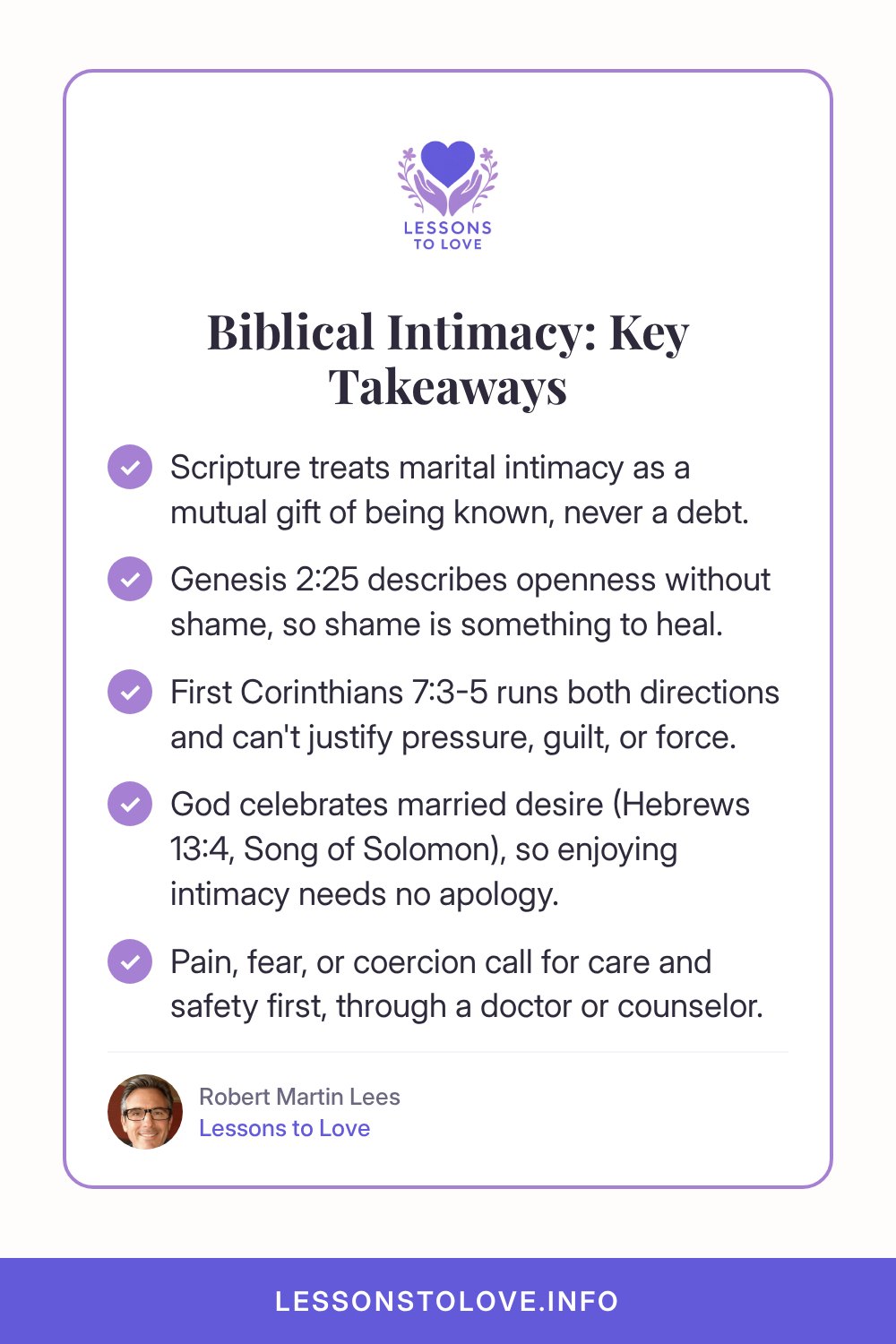
The short answer: The Bible teaches that intimacy in marriage is a mutual gift of knowing and being fully known. Genesis 2:24-25 describes a one-flesh union without shame, Hebrews 13:4 calls the marriage bed honorable, and 1 Corinthians 7:3-5 asks both spouses to give freely and agree together, never through pressure, guilt, or force.
Key takeaways
- Scripture treats marital intimacy as a mutual gift of being known, never as a debt one spouse collects.
- Genesis 2:25 describes openness without shame, so shame in marriage is something to heal, not a sign you’re broken.
- First Corinthians 7:3-5 runs both directions between spouses and can’t be used to justify pressure, guilt, or force.
- God celebrates married desire (Hebrews 13:4, Song of Solomon), so enjoying intimacy doesn’t need an apology.
- Pain, fear, or coercion call for care and safety first, through a doctor, counselor, or confidential support.
The question under the question: “Do I owe my spouse sex? Am I sinning if I don’t want it, or don’t enjoy it?”
Take a breath. In Scripture, intimacy is a mutual gift given in love. It is never a debt collected under pressure. Not wanting sex tonight is not a verdict on your faith, and neither is struggling to enjoy it.
Your struggle is an invitation. It’s a call for care, honest conversation, and sometimes healing. It isn’t proof that you’re failing God.
“Isn’t that just justifying sin?” No. The Bible takes marriage seriously, and so do we. But taking it seriously means love, mutual respect, and faithfulness. It doesn’t mean guilt as a lever. We’ll walk through the key passages, including the one that gets misused most, so you can see this for yourself.
What does the Bible say about intimacy in marriage? Begin with knowing, not owing
Start where Scripture starts. Before there’s any mention of sex, God says something about loneliness.
Yahweh God said, “It is not good for the man to be alone. I will make him a helper comparable to him.” (Genesis 2:18, WEB)
It starts with an ache. Adam is surrounded by a garden full of life, and God still calls his aloneness “not good.” Marriage begins as an answer to a need for a fitting companion, not as a physical arrangement.
Then Scripture shows the joining:
Therefore a man will leave his father and his mother, and will join with his wife, and they will be one flesh. The man and his wife were both naked, and they were not ashamed. (Genesis 2:24-25, WEB)
Read Genesis 2:24 slowly and notice the order. Leaving, joining, becoming one. Bodies are part of it, but the whole picture is a person joining their life to another person.
And then there’s us, living after Eden. Most of us aren’t in the garden. We have baggage, tired bodies, and old hurts. Genesis gives us a picture of what God intends: being fully seen without fear. It doesn’t promise that every marriage starts there. Plenty of couples need patient repair to move toward it, and that’s not failure.
One flesh: closeness that involves the whole person
Scripture uses the word “know” for marital intimacy. In Genesis 4:1 we read:
The man knew Eve his wife. She conceived, and gave birth to Cain, and said, “I have gotten a man with Yahweh’s help.” (Genesis 4:1, WEB)
The Hebrew word behind “knew” is yada. It’s a word for personal, deep acquaintance, and here it carries the sexual meaning too. I don’t want to overstate it. One word doesn’t build a whole theology. But it does show that the Bible doesn’t separate the body from the person.
That gives us a pastoral way to think about it. I’ll call it three layers. This is a framework, not a formula the Bible lays out in three points:
- Emotional: feeling safe, heard, and understood by each other.
- Spiritual: sharing faith, honesty before God, and mutual care for each other’s soul.
- Physical: affection, touch, and sex, given freely.
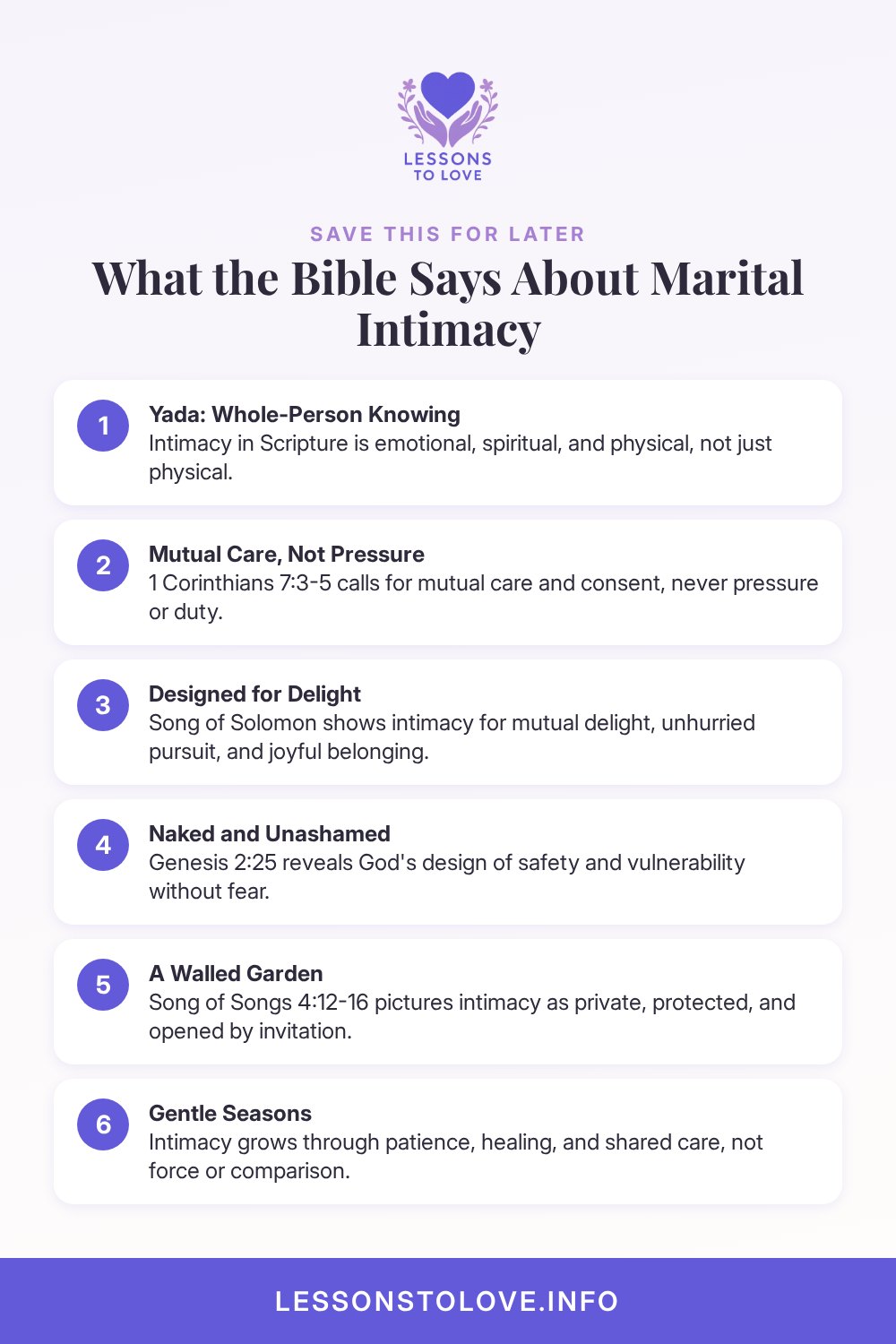
When one layer is cracked, the others feel it. A couple who haven’t had a real conversation in weeks often find the bedroom feels awkward too. That isn’t a spiritual failure. It’s how people work. The infographic below pulls together the main passages and ideas from this article.
What does “naked and unashamed” mean in Genesis 2:25?
It means more than no clothes. The couple has nothing to hide, and they aren’t afraid of being looked at. There’s no performing, no scoring, no flinching.
Notice what’s missing from that verse: pressure. Nobody is demanding, and nobody is bracing. Shame comes later in Genesis 3, and hiding comes with it. So if you feel shame in your marriage, that doesn’t mean you’re uniquely broken. It means you’re living east of Eden like everyone else.
The invitation is to move toward that original openness, slowly and safely. If you want to go deeper on the joyful side of this, our guide on Christian sexual pleasure picks up where this article leaves off.
Song of Solomon intimacy: tender invitation and mutual delight
If you want to know what God thinks about married desire, read the Song of Songs (also called the Song of Solomon). It’s a love poem, and it sits right in the middle of your Bible. It’s tender, a little playful, and surprisingly free of embarrassment.
Take it in three beats. First, the bride is a guarded garden, a protected place.
A locked up garden is my sister, my bride; a locked up spring, a sealed fountain. (Song of Solomon 4:12, WEB)
Then she speaks. She isn’t passive in this poem. She calls the wind to her garden and opens it herself.
Awake, north wind; and come, you south! Blow on my garden, that its spices may flow out. Let my beloved come into his garden, and taste his precious fruits. (Song of Solomon 4:16, WEB)
And he answers, and the poem celebrates. “I have come into my garden” (Song of Solomon 5:1) is followed by an invitation to eat, drink, and enjoy. You can read the whole poem in Song of Solomon 4.
The walled garden: privacy, protection, and invitation
I keep coming back to the garden because it says so much. A garden is walled. It’s private. And in this poem, it opens by invitation.
Gardens also don’t bloom on command. You can’t shout at a seed. They flourish with patient tending, the right season, and shared care. Force wrecks them.
A caution here: this poem is poetry. I’m not reading it as a modern consent code, and I’d never use it to treat a spouse as property. The pastoral point is simpler. Notice the pattern in the Song: tender words, invitation, response, and delight. Nobody takes. Both give.
That pattern is worth learning. It’s close to what the best communication tips for couples teach: slow down, speak kindly, ask before you assume.
Does God want married couples to enjoy sex?
Yes. I’d say it plainly, because many of us grew up hearing only the warnings.
The woman in the Song says, “I am my beloved’s. His desire is toward me” (Song of Solomon 7:10, WEB). Notice she’s confident, not apologetic. And then she takes the lead herself: “Come, my beloved! Let’s go out into the field” (Song of Solomon 7:11, WEB). She invites, which tells us mutual initiation is welcome.
Proverbs agrees. It tells a husband, “Let your spring be blessed. Rejoice in the wife of your youth” (Proverbs 5:18, WEB), and goes on to urge him to be captivated by her love always. That’s covenant delight, praised in Scripture.
One honest note. Scripture affirms pleasure, but nobody can command it into existence. If enjoyment feels far off right now, that isn’t disobedience. It’s a sign that something may need care, which we’ll get to.
What does 1 Corinthians 7:5 really mean for married couples?
Few passages have caused more hurt in Christian marriages. Some of you have heard it used like a contract. Let’s read it carefully, with 1 Corinthians 7:1-5 open beside you.
Let the husband give his wife the affection owed her, and likewise also the wife her husband. The wife doesn’t have authority over her own body, but the husband. Likewise also the husband doesn’t have authority over his own body, but the wife. Don’t deprive one another, unless it is by consent for a season, that you may give yourselves to fasting and prayer, and may be together again, that Satan doesn’t tempt you because of your lack of self-control. (1 Corinthians 7:3-5, WEB)
Read verses 3-5 together: reciprocal responsibility, not unilateral entitlement
Look at how every line runs both ways. Husband and wife. Wife and husband. Neither gets a one-sided claim. In Paul’s day that kind of equality was striking.
The only explicit exception Paul names is abstaining “by consent for a season” for prayer. So verse 5 speaks directly about mutual agreement. It doesn’t lay out a complete modern framework for sexual consent, and I won’t pretend it does.
But read it next to how Scripture describes love. Husbands are told to love “even as Christ also loved the assembly, and gave himself up for it” (Ephesians 5:25, WEB). Love like that gives itself up. It doesn’t take. A reading that allows threats, guilt trips, or forced sex can’t stand beside that kind of love.
Marriage doesn’t erase consent. Either spouse can say no, and a no still counts inside a wedding ring.
What if I worry that refusing intimacy is always a sin?
I’d gently say no. Not every “not tonight” is a moral failure. You might be sick, exhausted, grieving, hurting, or simply not feeling safe.
That said, a long pattern of pulling away deserves a caring conversation. Not an accusation, a conversation. Ask yourselves:
- What’s behind the distance: stress, pain, resentment, fear?
- Does each of us feel heard?
- Is there something we need help with?
Talking openly about needs is healthy. Demanding access is not. If you want help finding words, our piece on exploring sexual pleasure and desire is a gentle place to start.
What if my spouse uses this passage to pressure me?
Then the passage is being misused, and I’m sorry. Verse 3 is a call to give, not a license to take. “You have to, the Bible says so” isn’t how Paul’s words work.
If this is just pressure or hurt feelings, a calm conversation, maybe with a pastor or counselor, can help. But if there’s coercion, threats, or force, please hear me: your safety comes first. Find a trusted, confidential person to talk to on your own, such as a counselor or a domestic violence hotline in your area. Couples counseling can be unsafe when abuse is present, so start by getting private support.
What does the Bible say about intimacy in marriage beyond sex?
When we shrink intimacy down to intercourse, we hide a lot. Loneliness hides there. So does resentment, and so does a quiet sense of being used rather than loved.
Two people can share a bed for twenty years and never really know each other. And two people with a very quiet bedroom life can be deeply close. Scripture’s picture is bigger than the act.
Emotional and spiritual intimacy make room for being known
Paul opens his words to married couples with this: “subjecting yourselves to one another in the fear of Christ” (Ephesians 5:21, WEB). Mutual. It frames everything that follows, including the marriage bed.
Closeness can feed itself. Emotional connection, shared faith, and physical affection nourish each other. But none of them is a payment for the others. A kind conversation isn’t a down payment on sex, and a prayer isn’t a trick to get it. Once intimacy becomes a transaction, it stops being intimacy.
A few small ways to make room for being known:
- Listen without fixing. When she tells you about her day, skip the advice unless she asks.
- Share a fear. One honest sentence, like “I’ve been worried about money and I didn’t want to say it,” can change an evening.
- Offer a short blessing. “I’m thankful for you. God gave me a good one.” Ten seconds, and it lands.
- Ask first. Before praying about something sensitive, ask, “Would it be okay if we prayed about this together?”
If you want to go deeper on the physical side with care for each other, these two resources are written for this: how to please your wife and how to satisfy your husband, both with the same spirit of mutual care.

What if we pray together but still feel far apart?
That happens, and it doesn’t mean your prayers are empty. Prayer opens a door. It doesn’t replace the repair that needs to happen on the other side of it.
Treat spiritual habits as invitations, never as tests of faith. If a joint prayer feels forced or loaded, step back. Try a quiet walk first, or write each other a short note. Sometimes the honest conversation has to come before the shared prayer can feel real.
One question worth asking your spouse this week: “What helps you feel safe, known, and close to me?”
Only ask it if talking honestly is safe in your marriage. If you’re dealing with coercion, please seek private support instead of starting a vulnerable joint conversation.
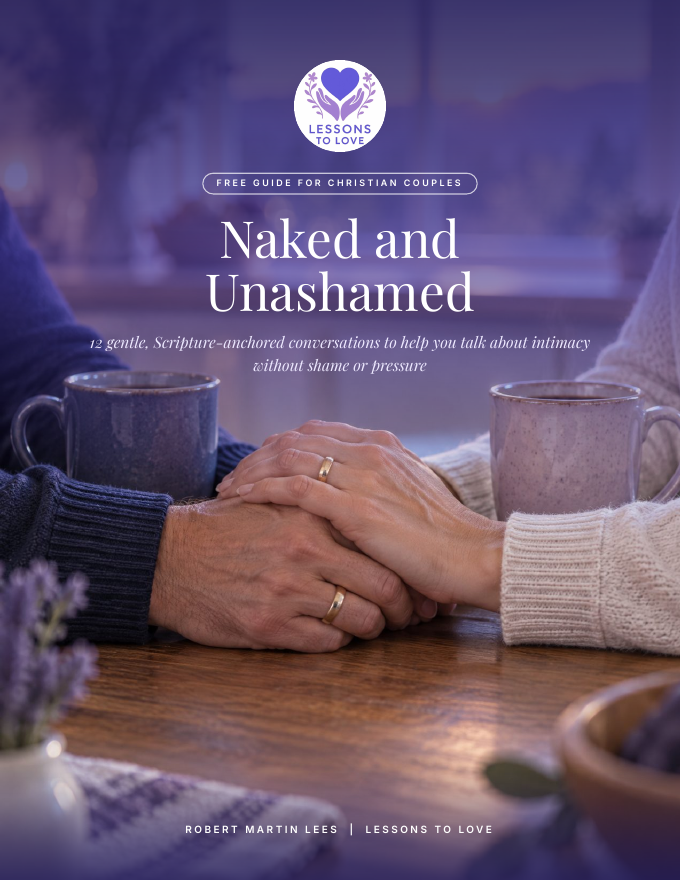
Free download
Not sure how to start the conversation?
Get Naked and Unashamed: 12 Conversations for Christian Couples. Twelve gentle conversation starters, each anchored in Scripture, to help you talk about intimacy without shame or pressure.
- 12 short conversation starters you can use tonight
- A Scripture anchor for every talk
- Gentle ground rules so nobody feels pressured
No spam. Unsubscribe anytime.
Christian marriage intimacy when desire differs or sex hurts
Almost every couple hits this wall. One person wants closeness more often than the other. It’s normal, and it doesn’t follow gender lines. In some marriages it’s the husband who wants more, in others the wife, and in some it swaps back and forth over the years.
What if one spouse wants sex more often?
Neither of you is the villain. The one who wants more isn’t a pervert, and the one who wants less isn’t cold. You’re two people with different rhythms.
A few things help:
- Talk about needs without keeping score. “You never initiate” shuts a conversation down. “I miss feeling wanted” opens one.
- Try affection with no expectation of more. A long hug or a shoulder rub that doesn’t have to lead anywhere can lower the pressure.
- Ask what makes desire easier. Sleep? A quieter house? More emotional connection first?
The Gottman Institute offers research-based material on communication in marriage, and many couples find it a helpful outside voice. For a trained guide, online therapy for couples is a convenient option when finding a local counselor is hard. (That’s an affiliate link, as noted above.)
What if postpartum changes, illness, or grief affect desire?
Then give each other grace. Desire can drop with a newborn in the house, a long illness, a death in the family, or a hard season of caring for aging parents. Sleep, medications, hormonal changes, and relationship strain all play a part. I can’t diagnose any of that for you, and I won’t try. A doctor can.
These seasons are like winter in a garden. Nothing looks like it’s growing, but the garden isn’t dead. Gentle care, patience, and warmth can carry a marriage through. If it lingers and weighs on you, tell your doctor.
What if sex is painful or frightening?
Please hear this clearly: nobody has to endure painful sex to prove faithfulness. Not you, not your spouse.
If something hurts, stop. Pause that activity, and see a qualified healthcare professional. Depending on the situation, pelvic health care or trauma-informed therapy may help. Prayer can walk alongside professional care. It shouldn’t replace it, and “just pray harder” is not good advice for pain.
If fear comes from abuse, your immediate safety matters most. Reach out to confidential support and local emergency or specialist services. And please don’t “negotiate” how often to have sex under pressure or threat. That isn’t a conversation about desire. It’s a safety issue.
How do I overcome shame about sex after a Christian upbringing?
Many of us were raised to treat sex as dangerous right up until the wedding day. Then we were somehow expected to flip a switch. That doesn’t work, and it isn’t your fault.
Our turning point wasn’t a big fight. It was a quiet Tuesday night. I looked at my wife and realised I was looking at a stranger.
I started to see where the silence came from. The way I pulled back emotionally had roots in my own parents’ divorce, and it had broken our communication and starved our closeness. “I knew how to fix a crisis, but I had no idea how to build a connection.” That’s a hard thing to admit about yourself.
So I stopped blaming the world and started learning the language of intimacy, on purpose, like any skill I’d never been taught. Maybe your silence sounds different from ours. What would it look like to name it out loud this week?
Separate biblical convictions from harmful messages
I don’t want to wave away everything the church taught about purity. Scripture does call us to faithfulness, and conviction about that is worth keeping. But some messages grew on top of that and aren’t in the Bible:
- “Your body is a stumbling block” or “desire is dirty.”
- “A good Christian girl doesn’t want sex,” or “a good Christian man can’t control himself.”
- “If your sex life is good, your faith is strong” (and the reverse).
Compare those with Scripture: “Let marriage be held in honor among all, and let the bed be undefiled” (Hebrews 13:4, WEB). Undefiled. God doesn’t call the marriage bed dirty.
Try swapping shame-based thoughts for truthful, kind ones. “I’m bad for wanting this” becomes “God made me with a body, and desire in marriage is not a sin.” It will feel awkward at first. Say it anyway.
It also helps to read widely and wisely. Focus on the Family has marriage resources from a Christian perspective, and if the topic of pornography and sexual intimacy is part of your story, that article is written with grace.
What if I waited for marriage and intimacy still feels difficult?
You’re not alone, and you didn’t do it wrong. A wedding doesn’t undo years of fear, silence, or misinformation. Learning to enjoy your spouse is a skill, and skills take time.
Be patient. Learn together. Talk openly, laugh a little, and pursue trustworthy education about how bodies work. Many couples feel clumsy for a long time, and that’s okay.
What if past experiences make closeness feel unsafe?
If you’ve experienced abuse or assault, please know it was not your fault. Not even a little. Healing is possible, and it goes at your pace.
You don’t have to tell your spouse every detail. You don’t have to submit to touch you don’t want while you heal. A licensed, trauma-informed counselor who respects your faith and your choices can walk with you. Ask about that up front when you call.
Back to the garden: healing needs protection and patient tending. Nobody forces a bloom, and that includes you.
How can Christian couples grow closer emotionally and spiritually?
Here’s a gentle six-step conversation you can try together. It’s meant for marriages where speaking honestly is safe. If there’s coercion or abuse, please seek confidential individual support instead.
- Choose a Calm Moment: Pick a quiet, private time that isn’t connected to sexual initiation. Not in bed, and not right after an argument. Ask, “Would you be willing to talk about how we’re connecting? Maybe Saturday morning over coffee?”
- Agree on Safety: Set ground rules before you start. Either of you can pause at any time, and this conversation does not create any obligation to have sex. Try saying, “If this gets heavy, we can stop. And nothing we say tonight means anyone owes anything.”
- Share Without Blame: Take turns finishing two sentences: “I feel close when…” and “I feel pressure when…” Keep it about yourself. “I feel close when you ask about my day” works. “You never ask about my day” doesn’t.
- Reflect Before Responding: Before you answer or fix anything, repeat back what you heard. “What I’m hearing is that you feel pressure when I reach for you late at night. Is that right?” Then let your spouse correct you. This one step prevents more fights than almost anything.
- Choose One Small Practice: Pick one thing you both welcome. It could be a ten-minute check-in after dinner, a short shared prayer, or affection with clearly agreed limits. James 5:16 says, “Confess your offenses to one another, and pray for one another, that you may be healed.” Honest prayer together can be part of that, if you both want it.
- Revisit with Kindness: After a week, check in. “How did that feel for you?” Adjust, keep what helps, drop what doesn’t. If pain, distress, or disconnection continues, don’t wait. Reach out to a doctor or a counselor.
Small steps beat grand gestures.
What is allowed in the bedroom for Christian couples?
Couples ask this quietly, and often with worry. The honest answer starts with what Scripture says and, just as importantly, what it leaves open.
Honor the marriage bed without inventing a rule for every act
Go back to Hebrews 13:4: “Let marriage be held in honor among all, and let the bed be undefiled: but God will judge the sexually immoral and adulterers.” In context, it honors marriage and marital faithfulness. It isn’t blanket approval of every possible act. And it isn’t a detailed rulebook either.
Christian traditions disagree on a few specific questions. I’m not going to pretend they don’t. I’d rather give you questions to ask than a list I can’t back up from Scripture.
Ask about consent, fidelity, dignity, and physical safety
When you wonder whether something fits your marriage, try these:
- Is it freely wanted by both of us? Not tolerated, not agreed to under pressure. Wanted.
- Does it honor our faithfulness and each person’s dignity?
- Is it physically safe?
- Can either of us say no without being punished? Silence, sulking, and guilt are all forms of punishment.
- Does it respect conscience? And is conscience being used to honestly stay true to God, rather than to control the other person?
Consent is necessary, but it doesn’t settle every ethical question on its own. Both of you still bring your faith and your conscience to it. And marriage never requires you to agree to a particular act.
Some couples also wonder where imagination fits. We’ve written about the role of fantasy in Christian marriage with care for both freedom and faithfulness.
What if we disagree about a practice?
Then the answer is no, for now, and no pressure. Love goes at the pace of the more hesitant person. Talk about why it matters to each of you. Sometimes it’s curiosity, sometimes it’s fear, and sometimes it’s something deeper that deserves a pastor’s or counselor’s ear.
A disagreement isn’t a crisis. Handled kindly, it can actually build trust. If you want more help with mutual, unhurried enjoyment, our guide on enhancing sexual pleasure in a Christian marriage goes further. It’s meant for joy, not as a fix for pain or coercion. If you’d like something more structured for growing closer at a gentle pace, there’s also our honest review of the Lust Inception program. It is written mainly for wives who want to rebuild desire, so read the review first and decide together whether it fits your marriage.
What Couples Are Saying
Ready to tend your garden together?
You don’t have to fix everything tonight. Pick one small thing: ask the question, take one breath, make one phone call. Gardens grow slowly, and so do marriages.
Your story isn’t over, and neither is God’s kindness toward the two of you. If you’d like to keep going, our guide to Christian sexual pleasure is a warm next step, written for mutual, unhurried delight.
Grow Closer With Joy, Not Pressure
Frequently Asked Questions
What does the Bible say about intimacy between husband and wife?
The Bible presents marital intimacy as a mutual gift of knowing and being fully known, not a debt one spouse collects from the other. Genesis 2:24-25 describes a one-flesh union with openness and no shame, and the Hebrew word yada (“knew”) ties physical closeness to whole-person closeness. Think of it as a garden you tend with patience, not a transaction you enforce.
Is it a sin to say no to sex with my spouse?
Saying “not tonight” is not automatically a sin, because sickness, exhaustion, grief, pain, or feeling unsafe are real reasons, and a no still counts inside marriage. Scripture speaks to a pattern of withholding that wears down the relationship, and that calls for honest conversation, not accusation. If refusal becomes punishment or control, bring that deeper issue to a pastor or counselor.
Does God want married couples to enjoy sex?
Yes, God wants married couples to enjoy sex, and Scripture celebrates marital delight openly in Song of Solomon 7:10 and Proverbs 5:18-19. Hebrews 13:4 calls the marriage bed honorable and undefiled, which is far more than tolerated. If enjoyment feels distant right now, that points to a need for care and healing, not proof you’ve disobeyed.
What does naked and unashamed mean in Genesis 2:25?
Naked and unashamed in Genesis 2:25 means the first couple had nothing to hide and no fear of being fully seen, which goes beyond having no clothes. There’s no performing, scoring, or bracing in that verse, and shame only shows up in Genesis 3. So feeling shame in your marriage doesn’t make you uniquely broken. It means you live east of Eden, moving toward restoration.
What does 1 Corinthians 7:5 really mean for married couples?
First Corinthians 7:5 means mutual agreement between spouses, not one-sided obligation, since every line in verses 3-5 runs in both directions. The only abstaining Paul names is by consent, for a season of prayer, which assumes both people choose it together. Read beside Ephesians 5:25, the passage can’t support pressure, guilt, or forced sex.
How can Christian couples grow closer emotionally and spiritually?
Christian couples grow closer through small, steady habits: listening without fixing, sharing one honest fear, offering a short blessing, and asking before praying about something sensitive. Ephesians 5:21 frames marriage as mutual submission, so closeness grows when neither person treats connection as payment for something else. A calm talk outside the bedroom about feeling close and feeling pressure can open the door.
What is allowed in the bedroom for Christian couples?
Scripture gives Christian couples principles for the bedroom, not a detailed list of permitted acts: mutual consent, honor, and love that gives rather than takes. Hebrews 13:4 calls the marriage bed undefiled, and 1 Corinthians 7:5 assumes agreement between spouses. Anything involving pressure, coercion, or one spouse’s discomfort falls outside that pattern, whatever the act.
How do I get past shame about sex after a Christian upbringing?
You get past sexual shame by separating biblical conviction from messages the Bible never taught, like “desire is dirty” or “a good Christian doesn’t want sex.” Hebrews 13:4 calls the marriage bed undefiled, so God doesn’t call married desire shameful. Swap shame-based thoughts for truthful ones, and give yourself time, since a wedding day doesn’t erase years of fear or silence.
What if my spouse uses 1 Corinthians 7 to pressure me for sex?
A spouse who uses 1 Corinthians 7 to pressure you is misusing the passage, because verse 3 calls each person to give, not to take. It never authorizes pressure or guilt. If this is hurt feelings, a pastor or counselor can help you talk it through. If there’s coercion, threats, or force, your safety comes first, so seek confidential individual support, such as a domestic violence hotline, rather than couples counseling.
What if sex is painful or frightening for me as a Christian wife?
No Christian wife has to endure painful sex to prove her faithfulness, and “just pray harder” is not good advice for physical pain. Stop what hurts and see a qualified healthcare professional, since pelvic health care or trauma-informed therapy may help depending on the cause. If the fear comes from abuse, your safety matters most, so reach out to confidential support and local services.
Save these to Pinterest
Pin them to your marriage board so you can come back to them together.

Related Posts
- Enhancing Sexual Pleasure in a Christian Marriage
- Role of Fantasy in Christian Marriage
- Pornography & Intimacy in Christian Marriage

About the author: Robert Martin Lees
Robert writes Lessons to Love to help Christian husbands and wives build honest, passionate, God-honoring marriages. Read Robert’s story.