

How to Talk About Sex With Your Spouse When It Feels Awkward
Some links in this article are affiliate links. If you buy through them we may earn a commission, at no extra cost to you. We only recommend resources we believe honor marriage.
You’ve rehearsed it in the shower. You’ve rehearsed it while folding laundry. Then your spouse walks in, and your mouth goes dry. Learning how to talk about sex with your spouse can feel harder than the act itself, and the fear underneath is usually the same: “What if I say it wrong and hurt them?”
If that’s you, nothing is wrong with you. Plenty of faithful, loving couples sit in the same bed every night with the same unspoken questions. Awkward doesn’t mean broken.
Scripture gives you more permission here than most of us were ever taught. In Song of Songs, a bride and groom speak to each other about longing, delight and desire, out loud and on purpose. God put that conversation in the Bible.
So here’s what we’re going to do. We’ll look at why the words get stuck, what Scripture says about spoken intimacy, and a simple seven-step way to start. We’ll also cover how to listen well, what to say on tender topics, and how to repair things when a talk goes sideways.
Go slow. You don’t need to fix anything tonight.
The short answer: To talk about sex with your spouse, choose a calm, private moment and ask permission first. Share one appreciation, one feeling, and one question, then listen without defending yourself. Keep it short, name a hope instead of a complaint, and thank them for any answer. If they need time, agree on another day.
Key takeaways
- Start the conversation with affection and permission, so your spouse hears an invitation instead of a complaint about the marriage.
- Keep the first talk short: one appreciation, one feeling, and one question, with nothing that has to be solved that night.
- Scripture treats married desire as good and speakable, so open conversation about sex fits a Christian marriage rather than threatening it.
- If your spouse says not now, ask for another time, and don’t punish the delay with silence or nightly pressure.
- Bring in a counselor when distress grows, conversations stay shut for months, or pain, coercion, or past trauma is involved.
“If I bring it up, won’t I hurt my spouse, start a fight, or kill the romance? Shouldn’t this just come naturally if our marriage is healthy?”
Honest worry. But silence isn’t protecting your marriage. It just leaves your spouse guessing, and guessing usually lands on the worst possible answer: “I’m not wanted,” or “I’m failing.” Scripture shows lovers who talk to each other, and a gentle, well-timed conversation is one of the most loving and romantic things you can offer.
“Is this just justifying sin?” No. We’re talking about a husband and wife speaking honestly inside the covenant God gave them. Nothing here asks you to drop your convictions. It asks you to bring them into the room with love, not leave them outside as a wall of silence.
Why Is It So Hard to Talk About Sex in Marriage?
Because a healthy marriage doesn’t make this automatic. You can pay bills together, raise kids together and pray together for twenty years, and still freeze when the topic is your bedroom. Talking about sex in marriage is a skill, and most of us never saw it modeled.
It’s also a skill that needs safety. If you’re afraid of how your spouse will react, with anger, threats or punishment, that’s a different situation, and we’ll come back to it near the end. Nobody should be urged into a vulnerable conversation with someone who uses it against them.
When silence, shame, or past hurt steals your words
Ordinary awkwardness is one thing. Shame is another. Shame often arrives from places we didn’t choose: a church youth talk that made desire sound dangerous, a family that never said the word “sex” once, a careless comment about your body, or a past hurt you’ve never told anyone.
Many Christians were taught, rightly, that sex belongs inside marriage. That conviction is worth honoring. The trouble comes when “wait” quietly turns into “this is dirty,” and then a wedding day is supposed to flip a switch. Bodies and hearts don’t work that way.
God’s original picture is a welcome, not a performance:
Therefore a man will leave his father and his mother, and will join with his wife, and they will be one flesh. The man and his wife were both naked, and they were not ashamed. (Genesis 2:24-25, WEB)
“Naked and unashamed” isn’t a demand that you feel completely open by Friday. It’s where the story starts, and where grace can slowly lead you back. If you freeze, blush or can’t find a single word, that isn’t proof of spiritual failure. It’s proof you’re human. For more on the wider skill, our guide to communication tips for Christian couples is a good companion.
What if talking about sex kills the romance?
Most couples fear the opposite of what happens. A kind, specific, well-timed conversation tends to build trust, and trust is what makes closeness feel safe enough to enjoy. What kills romance is resentment that sits for years without a name.
Emotional intimacy grows through small, safe exchanges, a bit like strength training. You don’t start with the heaviest weight. You start with one honest sentence and see that you both survived it.
Is It Biblical for Christian Couples to Talk Openly About Sex?
Yes. If you want to read what Scripture actually says about intimacy, open Song of Songs and keep reading. And if you’re wondering whether sexual enjoyment is something Christians are even allowed to want, our article on how God designed sex for married couples to enjoy goes deeper. Here we’ll focus on the talking.
Song of Songs gives desire a voice
Picture the scene the poet paints. There’s distance at first. The beloved stands outside, looking in, and the bride is somewhere hidden. Then he speaks, and what he asks for is more than her presence.
My beloved spoke, and said to me, “Rise up, my love, my beautiful one, and come away. For, behold, the winter is past. The rain is over and gone. The flowers appear on the earth. The time of the singing has come, and the voice of the turtledove is heard in our land. The fig tree ripens her green figs. The vines are in blossom. They give out their fragrance. Arise, my love, my beautiful one, and come away.” My dove in the clefts of the rock, In the hiding places of the mountainside, Let me see your face. Let me hear your voice; for your voice is sweet, and your face is lovely. (Song of Solomon 2:10-14, WEB)
“Let me hear your voice.” That invitation is the one many of us long to hear from a spouse, and the one we’re slow to offer. Making room for your spouse’s honest words, even the clumsy ones, echoes what this lover does. To be clear, this is poetry and a pastoral application, not a transcript of a couples’ counseling session.
Later the groom speaks about her specifically and warmly (Song of Songs 4:1-7). Notice the tone: appreciative, detailed, unhurried. You don’t have to copy his metaphors, and your wife will probably be glad you don’t compare her teeth to sheep. The point is that spoken delight is part of the picture.
Catch the little foxes before resentment grows
Another image. The vineyard is in bloom, which means something good is growing, and the lovers say this:
Catch for us the foxes, the little foxes that plunder the vineyards; for our vineyards are in blossom. (Song of Solomon 2:15, WEB)
Notice they’re little foxes. Small things. A comment left hanging, a pattern of “not tonight” that nobody explains, a silence after a hard evening. The application is simple. Name small things early and gently, before they chew through the roots.
By agreement: harmony without pressure
Paul writes to a married church about the bedroom in plain language:
Let the husband give his wife the affection owed her, and likewise also the wife her husband. The wife doesn’t have authority over her own body, but the husband. Likewise also the husband doesn’t have authority over his own body, but the wife. Don’t deprive one another, unless it is by consent for a season, that you may give yourselves to fasting and prayer, and may be together again, that Satan doesn’t tempt you because of your lack of self-control. (1 Corinthians 7:3-5, WEB)
The word behind “consent” is symphonos, which means agreed or harmonious. Yes, it’s where we get “symphony.” That’s an illustration, not proof of a modern consent framework, but it fits.
Think of two musicians before a concert. They tune to each other first, and those scratchy notes are awkward. They come before the music, not instead of it. Honest conversation is how a couple tunes.
One thing needs to be said clearly. Marriage never justifies coercion. Both spouses give, and either spouse may say no. A harmony that only one person gets to sing isn’t harmony.
How to Talk About Sex With Your Spouse in 7 Small Steps
This is the part you can use tonight. The infographic below sums up the sequence, and the list walks through it. If you want a wider look at the topic afterward, there’s more in exploring sexual pleasure and desire together.
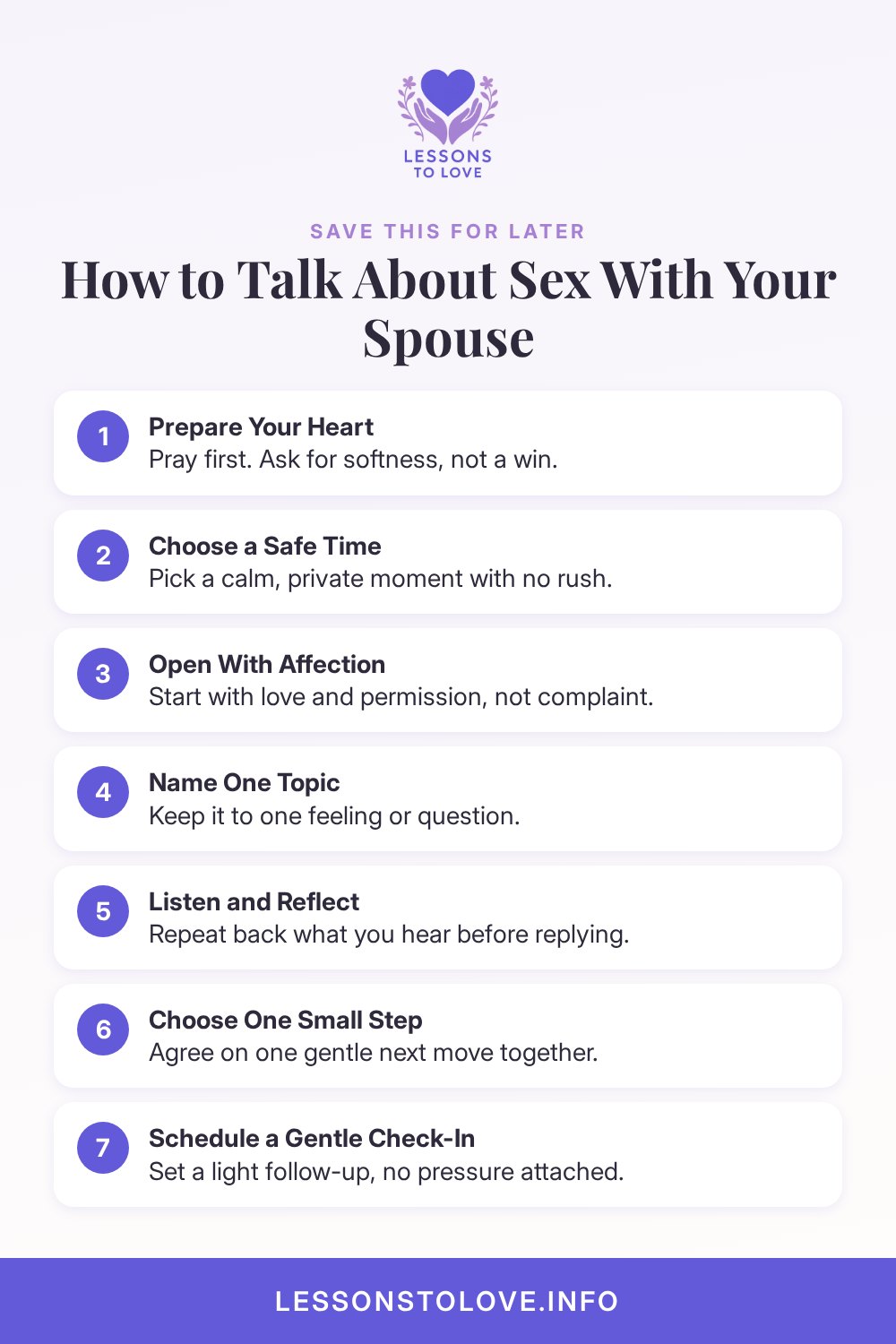
- Prepare Your Heart: Before you say a word, get clear on one appreciation, one feeling, and one question you want to ask. Not a case against your spouse, just three honest things. If you can’t say it in two sentences, it’s probably still too tangled to start.
- Choose a Safe Time: Pick a private, unhurried moment away from the bedroom, away from rejection, and away from a fight. A walk or a drive after the kids are asleep works well. Skip the moment you’ve just been turned down, when everything sounds like an accusation.
- Open With Affection and Permission: Try this: “I love you, and I want us to feel closer. Would you be open to a short conversation about our sex life?” Then wait for an answer. If you both want it, a quick prayer for gentleness can help, as long as it never replaces listening or becomes a way to claim God’s side.
- Name One Topic: Just one. Use specific observations (“I’ve missed us being close on weekends”) instead of “always” and “never.” Those two words end more conversations than any other.
- Listen and Reflect: Both of you do this. Before answering, summarize what you heard: “So you’re saying you feel pressure when I reach for you late at night. Did I get that right?” We’ll spend a whole section on this skill next.
- Choose One Small Next Step: Agree on a tiny experiment that doesn’t require sex at all. Maybe it’s twenty minutes of unhurried touch, a text during the day, or saying “not tonight, but tomorrow?” out loud and warmly.
- Schedule a Gentle Check-In: Pick a time within a week or two to ask, “How did that feel?” Keep it brief. A short follow-up tells your spouse this wasn’t a one-time ambush.
What if we have never talked about sex before?
Then start with the five-minute version. One appreciation, one feeling, one question. Nothing has to be resolved.
It might sound like this: “I really loved how close we felt on our anniversary. I get a little nervous talking about this stuff. Is there anything you wish we talked about more?” Then stop. Thank them for whatever they say, even if it’s “I don’t know.” Many couples need a couple of those small talks before the real ones feel possible.
What if my spouse does not want to talk right now?
Ask for another time instead of pushing. “Would later this week work better?” keeps the door open without trapping anyone. Don’t punish the delay with silence or sulking, and don’t bring it up again every night.
Sometimes “not now” is simply tired or tender. If a spouse refuses every time, for months, that’s information worth bringing to a counselor, and we’ll cover that in the last section.
The turning point for us wasn’t a big fight. It was a quiet Tuesday night. I looked across at my wife and realised I was looking at a stranger.
I saw it then. I’d learned to pull away from my parents’ divorce, and that same habit had cut off our talking and starved our intimacy. “I knew how to fix a crisis, but I had no idea how to build a connection.” Nobody had ever shown me the second skill.
So I stopped blaming everything else and decided to learn the language, one small step at a time. If the words stick in your throat too, you’re not broken, you’re just where I was.
Why Listening Makes Talking About Sex in Marriage Safer
Here’s what a spouse remembers after a hard conversation: whether they felt heard. Not whether the words were perfect. That memory decides whether honesty feels possible next time.

If speaking up leads to defensiveness, an eye roll or a lecture, your spouse learns to stay quiet. If it leads to “thank you for telling me,” they learn it’s safe. Researchers at the Gottman Institute have written about how listening and emotional safety shape marriages, and you can see Gottman’s research on listening and emotional safety for yourself. Scripture said it first, though:
So, then, my beloved brothers, let every man be swift to hear, slow to speak, and slow to anger; (James 1:19, WEB)
Receive feedback without defending your worth
When your spouse shares something hard, your body may hear “you’re a failure” even when they said nothing of the sort. Try this four-part response:
- Thank them. “Thank you for telling me.”
- Reflect what you heard. “I hear that you’ve felt lonely when I turn away without explaining.”
- Check it. “Have I understood?”
- Ask what would help. “What would feel good to you this week?”
Put together, it sounds like: “Thank you for telling me. I hear that you have felt lonely when I turn away without explaining. Have I understood?” That’s it. No defense needed.
Validating isn’t the same as agreeing with every detail, and it isn’t a promise to perform. You can say “I understand why that hurt” without saying “so I’ll change everything by Friday.”
What if I feel criticized, overwhelmed, or tearful?
Tears are normal here. They don’t mean the conversation failed. If you’re the one crying, you can say so: “I’m tearing up, and I’m still listening.”
If you’re the speaker, you don’t have to drop your concern to comfort the other person right away. Offer a kind pause, then keep going when they’re ready.
If you’re flooded, take a regulated break. Say, “I need twenty minutes to settle. Can we come back at eight?” Then actually come back. A pause with a return time is care. A pause with no return is just leaving.
Try one ten-minute check-in this week.
Ask your spouse for ten optional minutes. No expectation of sex, and no sharing beyond what feels safe. Just two people practicing listening. If you want more practical ways to keep these talks calm and kind, start here.

Free download
Not sure how to start the conversation?
Get Naked and Unashamed: 12 Conversations for Christian Couples. Twelve gentle conversation starters, each anchored in Scripture, to help you talk about intimacy without shame or pressure.
- 12 short conversation starters you can use tonight
- A Scripture anchor for every talk
- Gentle ground rules so nobody feels pressured
No spam. Unsubscribe anytime.
Discussing Sexual Needs With Your Spouse: Words for Tender Topics
Knowing the steps is one thing. Finding the words is another. Below are paired scripts, one for the speaker and one for the listener, because both sides need sentences. Adjust them until they sound like you.
And remember 1 Corinthians 7: needs get voiced, and the answer comes by agreement, never by pressure.
How to bring up initiation, rejection, and fatigue
Speaker: “When tonight isn’t a good time, could we say that warmly so neither of us has to guess?”
Listener: “Yes. I don’t want you to feel brushed off. I’d like to say ‘not tonight, but I’m glad you reached for me’ and mean it.”
On fatigue, talk about the load, not just the mood. “I’m exhausted by the time the kids are down. Can we look at the dishes, the bedtime routine, and when we’re each at our best?” Tiredness is real, and it’s also fixable more often than we admit. Treating it as a permanent excuse or as a flaw in your spouse both miss the mark.
If you’re a husband reading this and wondering where to begin, start with this: your wife wants to know you notice her outside the bedroom too. If you’re looking for language for that, there’s a resource on words that help your wife feel desired.
How to name pain or feeling used and unseen
Speaker (pain): “This hurts, and I need us to stop. I would like help understanding why.”
Listener: “Thank you for telling me. We’ll stop, and we’ll find out what’s going on. I’m not asking you to push through.”
That’s the whole listening response. No negotiating tolerance, no “just a little longer.” Pain is a reason to stop and seek care.
Speaker (unseen): “I miss affection that doesn’t have to lead to sex.”
Listener: “I didn’t realize that. I’d like to touch you in ways that don’t come with a question attached. What feels good?”
There’s a line between disappointment and entitlement. Disappointment says “I miss you.” Entitlement says “you owe me.” One invites; the other corners. Ordinary disconnection is also not the same as coercion, and coercion is never a communication style.
What if I want to suggest something new?
Ask permission first: “Would you be open to hearing something I’ve been curious about?” Say what connection you hope for, without graphic detail. “I’d love for us to feel more playful together.”
Then welcome an unpressured no. Think about what you both believe, and whether it’s physically safe. No spouse owes experimentation, a full report on their past, or continued activity in the moment. A “no” today, said kindly, can protect a “yes” next month.
What Do We Do When One Spouse Wants Sex More Than the Other?
Desire discrepancy is not a verdict on love
Mismatched libido is among the most common things couples carry. One person isn’t “normal” and the other “broken.” Two different bodies with different rhythms, stresses and histories rarely line up neatly.
And yes, the higher-desire spouse is sometimes the wife, and the lower-desire spouse is sometimes the husband. Plenty of marriages look that way, and plenty of those couples feel strangely alone because nobody talks about it.
How to talk to your husband or wife without gender assumptions
If you are working out how to talk to your husband about sex or how to talk to your wife about sex, the same standards apply: kindness, curiosity, and each person’s right to answer freely. For husbands wanting to grow in care, pleasing your wife in bed starts with attention, and Lust Inception explores how desire actually builds.
Higher-desire script: “I’ve been feeling lonely lately, and I miss you. I’m not blaming you. I’d like to understand what it’s like on your side.”
Lower-desire script: “When I feel pressure, I pull back more. It isn’t you I’m rejecting. Can we find ways to be close that feel welcome to me?”
Then get curious together. Ask about stress, sleep, medications, health, strain between the two of you, and what tends to help desire show up. You aren’t diagnosing anyone at the kitchen table. You’re gathering clues.
What if we cannot agree on frequency?
Skip the quota. Numbers turn intimacy into a ledger, and a scheduled check-in doesn’t guarantee sex. Aim for understanding the pattern first, then choose a next step you both welcome.
If distress keeps growing on either side, that’s a sign to bring in qualified help. It isn’t a failure. It’s wisdom.
How to Talk About Sex With Your Spouse After a Conversation Goes Badly
Maybe it already happened. Voices rose, or someone went silent, or the words came out sharper than you meant. Now you’re not sure you can talk about this again.
You can. A bad conversation is a stumble, not a verdict.
Scripture includes disconnection in its love poetry, not only delight. Here the bride hears her beloved at the door and delays:
I was asleep, but my heart was awake. It is the voice of my beloved who knocks: “Open to me, my sister, my love, my dove, my undefiled; for my head is filled with dew, and my hair with the dampness of the night.” I have taken off my robe. Indeed, must I put it on? I have washed my feet. Indeed, must I soil them? My beloved thrust his hand in through the latch opening. My heart pounded for him. I rose up to open for my beloved. My hands dripped with myrrh, my fingers with liquid myrrh, on the handles of the lock. I opened to my beloved; but my beloved left; and had gone away. My heart went out when he spoke. I looked for him, but I didn’t find him. I called him, but he didn’t answer. The watchmen who go about the city found me. They beat me. They bruised me. The keepers of the walls took my cloak away from me. I adjure you, daughters of Jerusalem, If you find my beloved, that you tell him that I am faint with love. (Song of Solomon 5:2-8, WEB)
The poem opens on a missed encounter, then lets longing and distress speak, painful searching and all. This isn’t a how-to for apologies, and we’re certainly not endorsing the watchmen’s violence. It simply shows that love poetry in the Bible knows about missing each other.
From there the poem moves on to language of belonging again (Song of Songs 6:2-3). Distance isn’t the last word.
Pause without abandoning the conversation
First, settle. Walk it off, breathe, pray if that helps. Then name a return time: “I want to come back to this tonight after the kids are in bed. Is that okay?”
A pause is not the same as stonewalling. A pause says “I’ll be back.” Stonewalling says “this topic is closed.”
Apologize for the injury, then try a smaller conversation
Paul gives a pattern for repair that fits here:
Let no corrupt speech proceed out of your mouth, but only what is good for building others up as the need may be, that it may give grace to those who hear. Don’t grieve the Holy Spirit of God, in whom you were sealed for the day of redemption. Let all bitterness, wrath, anger, outcry, and slander, be put away from you, with all malice. And be kind to one another, tender hearted, forgiving each other, just as God also in Christ forgave you. (Ephesians 4:29-32, WEB)
In practice, repair has a shape. Own the specific words or behavior. Acknowledge the impact. Then ask to restart with something smaller.
Try: “I made my disappointment sound like an accusation. That hurt you, and I am sorry. You do not owe me sex. Could we try again when we both feel ready?”
Notice what that apology leaves out. No “but.” No “I’m sorry you felt that way.” Just the injury, the impact and an open door.
What if my spouse shuts down or refuses to revisit it?
Give it time. Then make the invitation smaller: “Could we talk for five minutes about something easy, like what you enjoyed about last weekend?” Small wins rebuild trust.
If a spouse refuses over and over, or punishes you with coldness whenever the subject comes up, that’s no longer a simple misstep. Bring it to a counselor.
And be clear on this: threats, intimidation or sexual pressure aren’t “communication mistakes.” They’re harm, and they belong in the next section, not in an apology script.
When Should a Christian Couple See a Counselor About Sex?
Sooner than most of us think. Getting help isn’t a sign your faith or marriage failed. It’s the same sensible move as seeing a doctor for a lingering cough.
Here are clear markers. Match yours to the right kind of help.
When pain or health changes need medical attention
See a physician or qualified sexual-health clinician if you notice persistent or new pain, bleeding, a sudden change in desire, or possible side effects from a new medication. A pelvic floor physical therapist may help when a clinician thinks it’s appropriate.
Please don’t push through painful intercourse. Pain is information, not a test of endurance. Stopping and getting it checked is loving, to yourself and to your spouse.
When trauma, recurring conflict, or pornography-related secrecy needs skilled care
Look for a licensed, trauma-informed therapist, or a qualified sex therapist who respects your Christian faith, if you notice:
- Flashbacks, panic, numbness or dread tied to touch or intimacy
- Repeated failed conversations that end in the same fight
- Pornography-related secrecy and broken trust
- Ongoing distress that doesn’t ease with time
A pastoral counselor can offer real spiritual support. But unless they’re also appropriately licensed, they don’t replace clinical expertise for trauma or sexual dysfunction.
When you interview someone, ask:
- Are you licensed, and in which state?
- What training do you have in sexual health?
- How do you work with trauma?
- How do you bring faith into sessions without spiritualizing problems away?
- Do you commit to noncoercive care, where neither spouse is pressured to perform?
If travel or schedules are a barrier, online therapy for couples can be a workable place to begin. I’m Robert Martin Lees, and I’m not a clinician, so I’ll say plainly that this article can’t stand in for a licensed professional.
What if saying no does not feel safe?
If you fear your spouse, if there are threats, forced sexual activity, or retaliation when you say no, this isn’t a communication problem. It’s a safety problem. Don’t use this article’s steps with that spouse.
Seek confidential individual support first, and contact a domestic or sexual violence service. Joint counseling may be unsafe when abuse is present. If you’re in immediate danger, call emergency services.
Your next step, depending on where you are: book a doctor’s appointment this week if pain is the issue, email two licensed Christian-friendly therapists to ask the five questions above if conflict or trauma is the issue, or reach out to a trusted, confidential support line if you’re afraid. Choose one and do it today.
What Couples Are Saying
Ready to Start the Conversation?
You don’t need perfect words. You need one gentle sentence, a good moment, and a willingness to listen. Try the opening line this week: “I love you, and I want us to feel closer. Would you be open to a short conversation about our sex life?”
Tune a little at a time. The awkward notes come before the music, and the music is worth it.
Frequently Asked Questions
How do I bring up sex with my spouse without hurting their feelings?
Bringing up sex gently starts with affection and permission, not a complaint. Try: ‘I love you and want us to feel closer. Would you be open to a short talk about our sex life?’ Then wait for their answer. Naming one specific hope, instead of a list of grievances, keeps it from landing as an attack.
Is it biblical for Christian couples to talk openly about sex?
Yes, the Bible supports Christian spouses talking openly about sex inside marriage. Song of Songs shows lovers voicing desire out loud, and 1 Corinthians 7:3-5 assumes spouses will discuss the bedroom and agree together. Open talk isn’t a concession to culture. It’s part of how the covenant works.
What should I say to my husband about our sex life?
A good opener to your husband is one appreciation, one feeling, and one question, kept to about five minutes. For example: ‘I’ve missed feeling close to you lately. I get nervous bringing this up. Is there anything you wish we talked about more?’ Then stop and let him answer.
How do I tell my wife what I want in bed as a Christian?
Tell your wife what you want by asking permission first: ‘Would you be open to hearing something I’ve been curious about?’ Describe the connection you hope for rather than graphic detail, and welcome a no without pressure. A kind no today often protects a warmer yes later.
Why is it so hard to talk about sex in marriage?
Talking about sex in marriage is hard because most of us never saw it modeled, and it needs a feeling of safety. You can run a household and pray together for twenty years and still freeze here. Shame from a youth talk, a silent family, or an old hurt makes the words stick.
What do we do when one spouse wants sex more than the other?
Mismatched desire is a pattern to understand together, not a verdict on love or a quota to hit. The higher-desire spouse can say, ‘I’ve been lonely and I miss you. I’m not blaming you.’ The lower-desire spouse can say, ‘When I feel pressure, I pull back. It isn’t you I’m rejecting.’ Then get curious about stress, sleep, health, and strain between you.
When should a Christian couple see a counselor about sex?
A Christian couple should see a counselor when distress keeps growing, when one spouse refuses every conversation for months, or when pain, coercion, or past trauma is involved. Getting qualified help isn’t a failure of faith. It’s wisdom (Proverbs 11:14 speaks of safety in many advisers).
How do you talk about sex after a conversation went badly?
After a bad conversation, name the stumble without relitigating it: ‘Last time I got sharp, and I’m sorry. I’d like to try again when you’re ready.’ One rough talk is a stumble, not a verdict on your marriage. Ask for a specific time to return to it instead of reopening it in the moment.
What if my spouse doesn’t want to talk about sex right now?
If your spouse isn’t ready to talk about sex, ask for another time instead of pushing: ‘Would later this week work better?’ That keeps the door open without trapping anyone. Don’t punish the delay with silence or sulking, and don’t raise it every night, which turns the topic into a siege.
How do we start talking about sex if we never have before?
Couples who have never talked about sex can start with a five-minute version: one appreciation, one feeling, one question, and nothing that must be resolved. It might sound like, ‘I loved how close we felt on our anniversary. I get nervous talking about this. Is there anything you wish we talked more about?’ Thank them for any answer, even ‘I don’t know.’
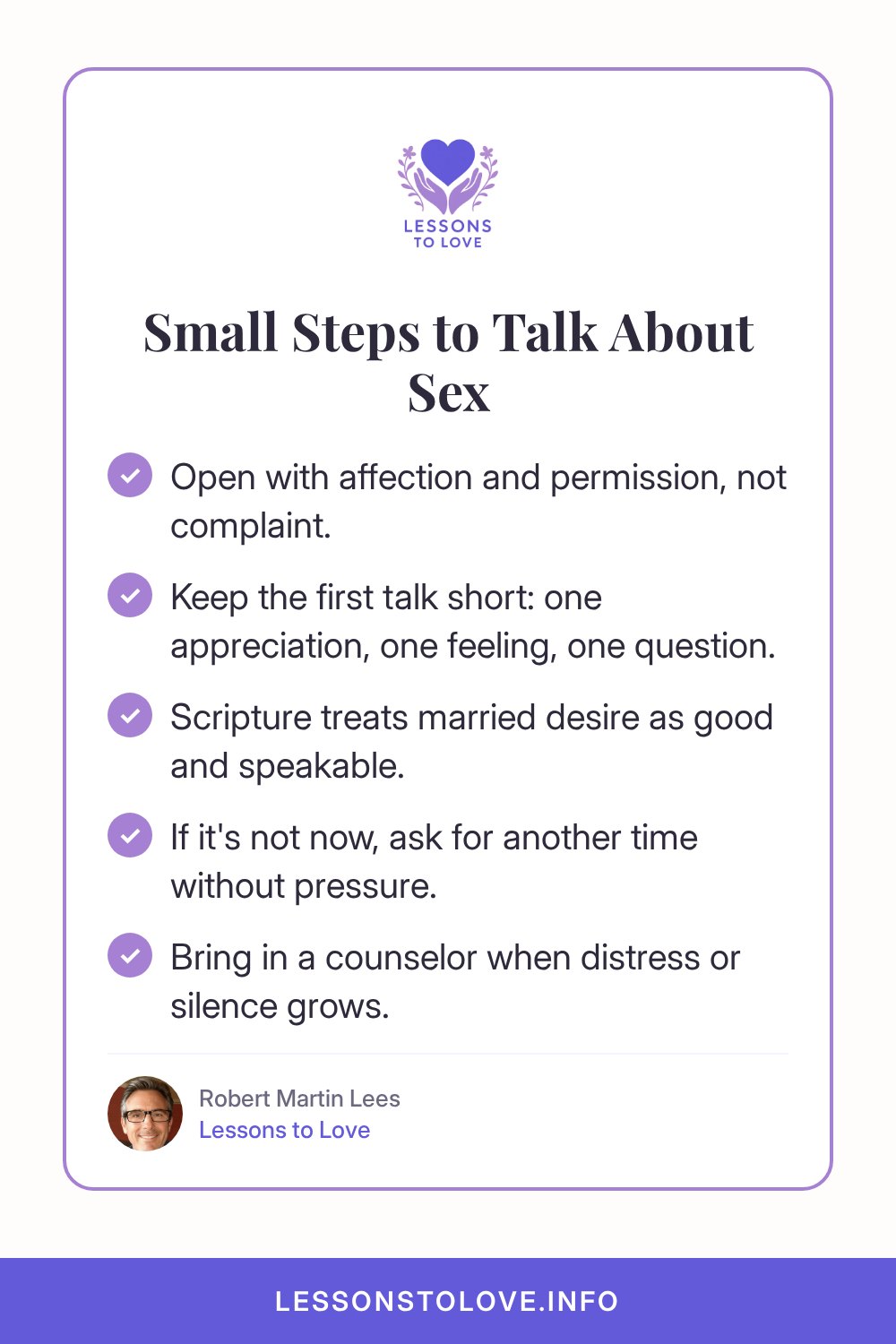
Save these to Pinterest
Pin them to your marriage board so you can come back to them together.

Related Posts
- How to Be a Good Wife
- How to Keep Your Husband Sexually Satisfied
- Christian Couple Communication Tips

About the author: Robert Martin Lees
Robert writes Lessons to Love to help Christian husbands and wives build honest, passionate, God-honoring marriages. Read Robert’s story.