

Christian Couple Communication Tips: 7 Biblical Strategies to Strengthen Your Relationship
Today, I’m going to be talking about how you, as a Christian couple, can cultivate a stronger connection by enhancing the way you communicate. This isn’t just about finding the right words to say; it’s also about how your shared faith can shape your conversations and deepen your bond.
You’re going to find out about the importance of integrating faith into your daily dialogue. Active listening and empathy, for instance, aren’t just interpersonal skills; they’re reflections of Christ’s teachings on love and understanding. It’s crucial to truly absorb what your partner is saying, and respond with compassion. When you master communication, you also strengthen intimacy in your marriage.
What does it mean to practice forgiveness and patience in your communication? It means emulating the patience God shows us, even when it’s tough. It’s about letting go of small grievances and focusing on resolving misunderstandings with a kind heart, remembering that no one, including ourselves, is without fault.
Prayer is another powerful facet of your communication toolkit. It’s not just for individual reflection. Prayer can be a joint endeavor to find common ground, seek peace in the midst of conflict, and invite God’s wisdom into your decisions and discussions.
Expressing gratitude isn’t a one-time thing; it’s a habit that fortifies your relationship. Regularly acknowledging each other’s strengths and contributions reinforces positive communication and ensures that both partners feel valued. And when you do this, the atmosphere between you becomes more nurturing and supportive.
Now, connection doesn’t happen without dedicated time. Setting aside moments for uninterrupted conversations means you’re making each other a priority. Whether it’s daily devotionals or just talking over coffee, these times are sacred. They allow you to engage fully without the distractions of the outside world.
In my opinion, emotional authenticity shouldn’t be underestimated. Being real about how you feel, while maintaining a respectful and loving approach, is key. It strengthens trust and shows that you’re both committed to being transparent, even when it’s challenging.
As we explore these strategies together, remember that effective communication in a Christian marriage isn’t just about what you’re saying or how you’re saying it. It’s also about why you’re saying it – to support each other, grow together in your faith, and reflect the love that God has shown each of us.
Here’s what we’ll explore:
Table of Contents
- 📖 Why Communication Is Important in Christian Relationships
- 💬 Best Communication Practices for Christian Couples
- ✝️ 7 Biblical Communication Tips for Christian Couples
- 🤝 Christian Couple Communication Exercises You Can Start Today
- 🎯 Christian Marriage Communication Strategies That Work
- 🚧 Improving Communication: Common Obstacles
- 💡 Top Relationship Tips Beyond Communication
- ❓ Frequently Asked Questions
Why Communication Is Important in Christian Relationships
Communication isn’t just a practical skill—it’s a spiritual discipline. When God created marriage, He designed it as a covenant relationship where two become one (Genesis 2:24). That unity doesn’t happen by accident. It requires intentional, consistent, and Christ-centered communication.
Think about how God communicates with us. He doesn’t leave us guessing. Through Scripture, through prayer, through the Holy Spirit, He speaks clearly and lovingly. He listens to our cries, our confessions, our praise. Our marriages should reflect that same pattern of open, honest, grace-filled dialogue.
Ephesians 4:29 reminds us: “Let no corrupting talk come out of your mouths, but only such as is good for building up, as fits the occasion, that it may give grace to those who hear.” Every word we speak to our spouse should build them up, not tear them down.
Poor communication is one of the leading causes of marital conflict. When couples stop talking—or worse, start talking at each other instead of with each other—resentment builds, intimacy fades, and the enemy finds a foothold. But when you prioritize godly communication, you create a safe space where both partners can be vulnerable, honest, and fully known.
Communication is the bridge between two hearts. It’s how you share your dreams, your fears, your needs, and your love. Without it, you’re just two people living parallel lives. With it, you’re partners walking together toward God’s purpose for your marriage.
Best Communication Practices for Christian Couples
So what does healthy, biblical communication actually look like? It’s more than just talking. It’s about how you listen, how you respond, and how you honor each other in the process.
Active Listening as Christ Listens
James 1:19 says, “Let every person be quick to hear, slow to speak, slow to anger.” Active listening means giving your spouse your full attention—not just waiting for your turn to talk. It means putting down your phone, turning off the TV, and truly hearing what they’re saying.
When your spouse is sharing something important, repeat back what you heard: “What I’m hearing is that you felt hurt when I didn’t ask about your day. Is that right?” This simple practice shows you’re listening and gives them a chance to clarify if you misunderstood. These skills are foundational to a thriving Christian marriage.
Speaking with Grace and Truth
Ephesians 4:15 calls us to speak “the truth in love.” Truth without love is harsh. Love without truth is shallow. But when you combine both, you create a communication style that’s honest yet compassionate.
If something is bothering you, don’t bottle it up. But don’t attack either. Use “I” statements: “I feel overwhelmed when the house is messy” instead of “You never clean up.” This keeps the conversation focused on your feelings, not accusations.
Timing and Tone Matter
Proverbs 15:1 teaches, “A gentle answer turns away wrath, but a harsh word stirs up anger.” How you say something is just as important as what you say. A soft tone, a gentle touch, and the right timing can make all the difference.
Don’t bring up heavy topics when your spouse is exhausted, stressed, or distracted. Ask, “Is now a good time to talk about something important?” Respect their answer. If they need time, give it. Communication works best when both people are ready to engage.
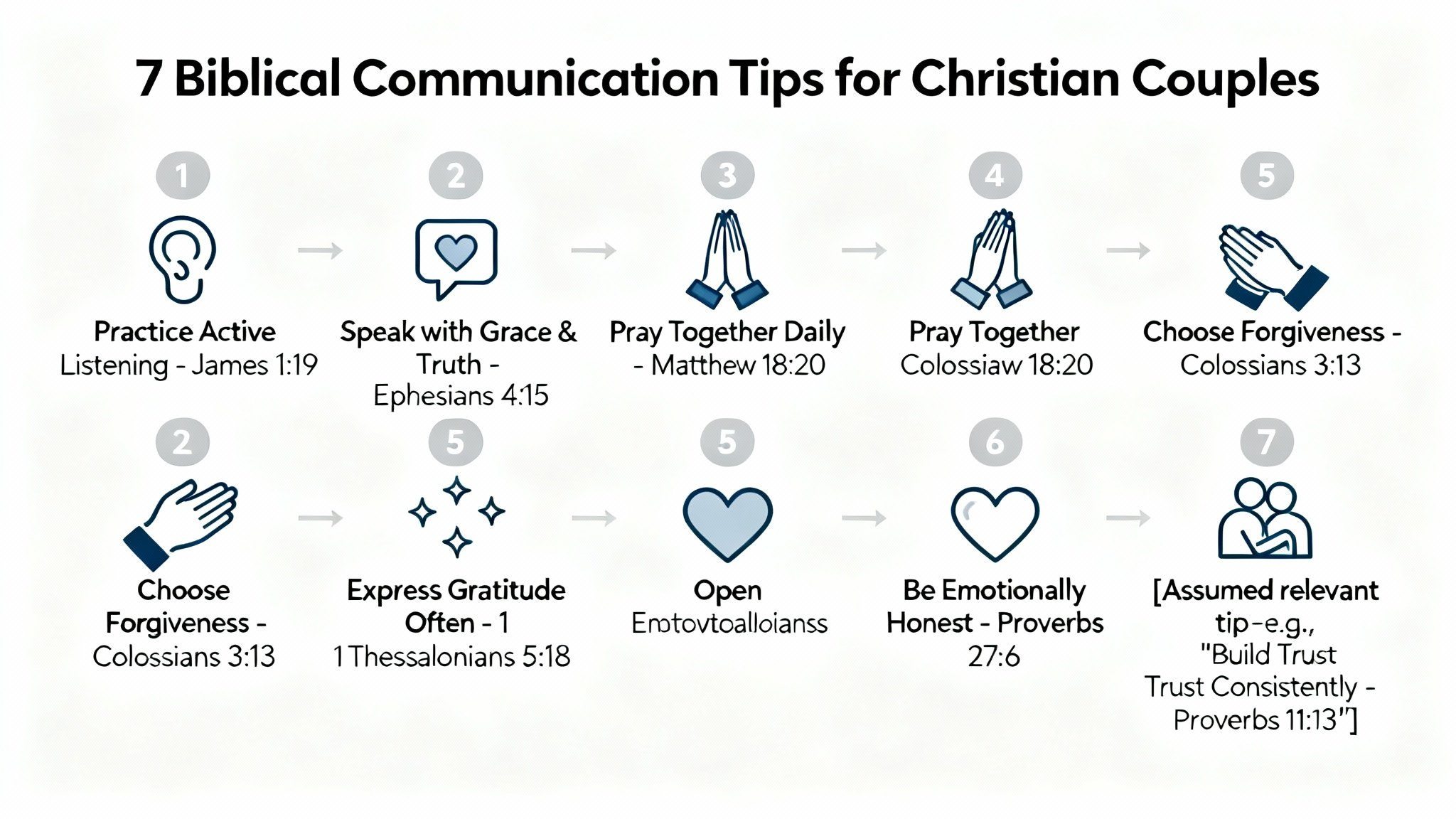
7 Biblical Communication Tips for Christian Couples
Now let’s dive into seven practical, scripture-based communication tips you can start using today. These aren’t just theories—they’re proven strategies that have strengthened countless Christian marriages.
Tip 1: Practice Active Listening (James 1:19)
We’ve already touched on this, but it’s worth repeating: listening is the foundation of all good communication. When your spouse is talking, resist the urge to interrupt, defend yourself, or plan your response. Just listen. Ask clarifying questions. Show empathy.
Try this: Set a timer for 5 minutes. Let your spouse share something on their heart without interruption. Then switch. You’ll be amazed at how much deeper your conversations become when you truly listen.
Tip 2: Speak with Grace & Truth (Ephesians 4:15)
Honesty without kindness is cruelty. Kindness without honesty is enabling. Find the balance. If your spouse asks for feedback, give it lovingly. If you need to address a concern, do it with grace.
Remember, your goal isn’t to win an argument. It’s to strengthen your marriage. Choose words that build up, not tear down.
Tip 3: Pray Together Daily (Matthew 18:20)
Matthew 18:20 promises, “Where two or three are gathered in my name, there am I among them.” When you pray together, you invite God into your marriage. You align your hearts with His will. You find unity even in disagreement.
Start small. Pray together before bed. Thank God for each other. Ask for wisdom in your communication. Pray for patience, understanding, and love. Over time, this habit will transform your relationship.

Tip 4: Choose Forgiveness & Patience (Colossians 3:13)
Colossians 3:13 says, “Bear with each other and forgive one another if any of you has a grievance against someone. Forgive as the Lord forgave you.”
You will hurt each other. You will say the wrong thing. You will misunderstand. That’s part of being human. But holding onto grudges poisons your marriage. Choose forgiveness—not because your spouse deserves it, but because Christ forgave you.
Patience means giving your spouse grace when they’re struggling to communicate. Not everyone processes emotions the same way. Some need time to think before they talk. Others need to talk to process. Honor each other’s differences.
Tip 5: Express Gratitude Regularly (1 Thessalonians 5:18)
1 Thessalonians 5:18 instructs, “Give thanks in all circumstances.” Gratitude shifts your focus from what’s wrong to what’s right. It reminds you why you fell in love in the first place.
Make it a habit to thank your spouse daily. “Thank you for making dinner.” “I appreciate how hard you work.” “I’m grateful for your patience with me today.” These small acknowledgments create a culture of appreciation in your marriage.
Tip 6: Be Emotionally Authentic (Proverbs 27:6)
Proverbs 27:6 says, “Faithful are the wounds of a friend.” True intimacy requires vulnerability. You can’t build a deep connection if you’re always pretending everything is fine.
Share your fears, your struggles, your joys. Let your spouse see the real you—not just the polished version. When you’re emotionally honest, you give your spouse permission to do the same. And that’s where real connection happens. This kind of emotional authenticity deepens intimacy in ways physical connection alone cannot.
Tip 7: Set Aside Sacred Time (Ecclesiastes 3:1)
Ecclesiastes 3:1 reminds us, “There is a time for everything.” Make time for uninterrupted conversation. No phones. No TV. No distractions. Just you and your spouse.
This could be a daily 15-minute check-in, a weekly date night, or a monthly weekend getaway. The point is to prioritize each other. When you make time for communication, you’re saying, “You matter. We matter.”
Want to Deepen Your Connection Even More?
Discover 500 powerful questions designed to spark meaningful conversations and strengthen your bond as a couple.
Get 1000 Questions for Couples →
Transform your conversations and rediscover each other
Christian Couple Communication Exercises You Can Start Today
Knowledge is great, but application is where transformation happens. Here are some practical exercises you can start using right now to improve your communication.
Daily Devotional Conversations
Read a Bible passage or devotional together each morning or evening. Then discuss: What stood out to you? How does this apply to our marriage? What is God teaching us through this?
This practice keeps your relationship grounded in Scripture and gives you a shared spiritual language.
Weekly Check-In Questions
Set aside 30 minutes each week to ask each other these questions:
- How did you feel loved by me this week?
- Is there anything I did that hurt you?
- What’s one thing I can do better next week?
- What are you looking forward to?
- How can I pray for you?
These questions create a safe space for honest feedback and keep small issues from becoming big problems. As you grow in communication, you’ll naturally find yourselves exploring deeper levels of intimacy in every area of your marriage.
Prayer Journaling Together
Keep a shared prayer journal where you write down prayer requests, answered prayers, and things you’re grateful for. Review it together monthly. You’ll be amazed at how God has been working in your marriage.
Scripture-Based Discussion Prompts
Choose a verse about marriage or communication and discuss it together. For example:
- 1 Corinthians 13:4-7 – How are we living out love in our communication?
- Proverbs 31:26 – How can we speak with wisdom and kindness?
- Philippians 2:3-4 – Are we considering each other’s needs above our own?
Christian Marriage Communication Strategies That Work
Beyond the basics, here are some advanced strategies that can take your communication to the next level.
The “Soft Startup” Approach
Research shows that how you start a conversation predicts how it will end. A harsh startup (“You never listen to me!”) leads to defensiveness. A soft startup (“I’d love to talk when you have a moment”) invites connection.
Start conversations gently. Use a calm tone. Begin with appreciation or affirmation before addressing concerns.
Using “I Feel” Statements
Instead of blaming (“You always ignore me”), express your feelings (“I feel lonely when we don’t spend time together”). This keeps the focus on your experience, not your spouse’s faults.
Format: “I feel [emotion] when [situation] because [reason]. I need [request].”
Example: “I feel disconnected when we don’t talk at dinner because I miss hearing about your day. I need us to have phone-free meals.”
The 24-Hour Rule for Conflict
If you’re too angry or hurt to communicate calmly, take a break. But don’t let it fester. Agree to revisit the conversation within 24 hours. This gives you time to cool down and pray, but prevents avoidance.
Ephesians 4:26 says, “Do not let the sun go down while you are still angry.” Resolve conflicts quickly, but wisely.
Seeking Godly Counsel When Needed
There’s no shame in asking for help. If you’re stuck in negative communication patterns, consider meeting with a pastor, Christian counselor, or trusted mentor couple. Proverbs 15:22 says, “Plans fail for lack of counsel, but with many advisers they succeed.”
Improving Communication in Christian Relationships: Common Obstacles
Even with the best intentions, you’ll face obstacles. Here’s how to overcome the most common ones.
Pride and Defensiveness
Pride says, “I’m right, you’re wrong.” It refuses to admit fault or apologize. But James 4:6 reminds us, “God opposes the proud but shows favor to the humble.”
Humility is the antidote to pride. Be quick to say, “I’m sorry. I was wrong. Will you forgive me?” Don’t defend yourself when your spouse shares how you hurt them. Just listen and apologize.
Past Hurts and Unforgiveness
If you’re holding onto past wounds, they’ll poison your present communication. You can’t move forward while clinging to the past.
Forgiveness doesn’t mean forgetting or excusing. It means releasing your spouse from the debt they owe you and trusting God to heal your heart. If you’re struggling, seek counseling or prayer ministry.
Busyness and Distraction
Modern life is noisy. Between work, kids, church, and social media, it’s easy to let communication slide. But busyness is a choice. You make time for what matters.
Schedule communication like you schedule everything else. Protect that time fiercely. Your marriage is worth it.
Different Communication Styles
Maybe you’re a verbal processor and your spouse needs time to think. Maybe you’re direct and they’re more indirect. These differences aren’t problems—they’re opportunities to grow in understanding.
Learn each other’s communication style. Adapt when you can. Extend grace when you can’t. Remember, you’re on the same team.
Top Relationship Tips for Christian Couples Beyond Communication
Communication is foundational, but it’s not the only thing that matters. Here are a few other ways to strengthen your marriage.
Serving Together
When you serve others as a couple—whether through church ministry, volunteering, or helping a neighbor—you build unity and purpose. You’re reminded that your marriage isn’t just about you. It’s about reflecting Christ’s love to the world and strengthening your marriage through shared mission.
Date Nights with Purpose
Don’t just go through the motions. Make your date nights intentional. Try new things. Ask deep questions. Laugh together. Flirt. Keep the romance alive.
Building Spiritual Intimacy
Pray together. Worship together. Study the Bible together. Attend church together. When your spiritual lives are aligned, everything else falls into place. Spiritual intimacy is the foundation that supports emotional and physical connection.
Resources and Tools
Invest in your marriage. Read books like The Meaning of Marriage by Tim Keller or Sacred Marriage by Gary Thomas. Listen to Christian marriage podcasts. Attend marriage conferences.
And if you want to take your conversations to the next level, check out 1000 Questions for Couples. These thought-provoking questions will help you discover new depths in your relationship and keep your conversations fresh and meaningful.

Ready to Transform Your Conversations?
Get instant access to 1000 powerful questions that will help you connect on a deeper level, resolve conflicts, and rediscover the joy in your relationship.
Join thousands of couples who are building stronger, more connected marriages
Frequently Asked Questions About Christian Couple Communication
How to improve communication in a Christian relationship?
Start by prioritizing active listening, praying together daily, and speaking with grace and truth. Use “I feel” statements instead of blame, and make time for uninterrupted conversations. Ground your communication in Scripture and seek to reflect Christ’s love in every interaction.
What are effective communication strategies for Christian couples?
Effective strategies include practicing active listening (James 1:19), speaking truth in love (Ephesians 4:15), praying together, choosing forgiveness quickly, expressing gratitude regularly, being emotionally authentic, and setting aside dedicated time for meaningful conversation.
How do I talk to my partner about faith in our relationship?
Start with your own testimony—share how God is working in your life. Ask open-ended questions like “How do you see God working in our marriage?” or “What’s one way we can grow spiritually together?” Make it a conversation, not a lecture. Pray together and study Scripture as a couple.
Why is communication important in Christian relationships?
Communication is essential because marriage is a covenant relationship designed by God for unity (Genesis 2:24). Without healthy communication, resentment builds, intimacy fades, and the enemy finds a foothold. Godly communication reflects how God communicates with us—clearly, lovingly, and with grace.
How do I express my feelings to my Christian partner?
Use “I feel” statements to express your emotions without blaming. For example: “I feel hurt when we don’t spend time together because I miss connecting with you.” Be honest but kind, and choose the right time and tone. Remember Ephesians 4:15—speak the truth in love.
What does the Bible say about communication in marriage?
The Bible emphasizes speaking with grace (Ephesians 4:29), listening before speaking (James 1:19), speaking truth in love (Ephesians 4:15), and resolving conflicts quickly (Ephesians 4:26). Proverbs 15:1 teaches that a gentle answer turns away wrath, while harsh words stir up anger.
How can prayer improve communication in a Christian marriage?
Prayer invites God into your conversations and aligns your hearts with His will. When you pray together, you practice humility, vulnerability, and unity. Prayer also helps you see your spouse through God’s eyes and gives you wisdom for difficult conversations.
What are some Christian couple communication exercises?
Try daily devotional conversations, weekly check-in questions, prayer journaling together, and scripture-based discussion prompts. You can also use tools like 1000 Questions for Couples to spark deeper conversations.
How do we overcome communication obstacles in our marriage?
Address pride and defensiveness with humility. Choose forgiveness for past hurts. Combat busyness by scheduling dedicated time for conversation. Honor each other’s different communication styles. If you’re stuck, seek godly counsel from a pastor or Christian counselor.
What if my spouse doesn’t want to communicate?
Pray for them and for your marriage. Model healthy communication yourself. Create a safe, non-judgmental space for them to open up. Ask gentle questions and listen without interrupting. If the issue persists, consider couples counseling. Remember, you can’t force change, but you can invite it through love and patience.
Final Thoughts: Choose Communication That Honors God
Effective communication in a Christian marriage isn’t just about what you’re saying or how you’re saying it. It’s about why you’re saying it—to support each other, grow together in your faith, and reflect the love that God has shown each of us.
Choose something that resonates with you from these tips, and you’ll be on your way to fostering a more meaningful connection. Start small. Be patient with yourself and your spouse. And remember, every conversation is an opportunity to honor God and strengthen your covenant. For more guidance on building a Christ-centered marriage, explore our resources on protecting intimacy in your relationship.
Your marriage is worth the effort. Your spouse is worth the effort. And God is faithful to bless the work you put into building a strong, Christ-centered relationship.
Ready to take your conversations to the next level? Discover 1000 Questions for Couples and start building the deep, meaningful connection you’ve been longing for.